
Abrahamic Footsteps in the Land of the Golden Lily
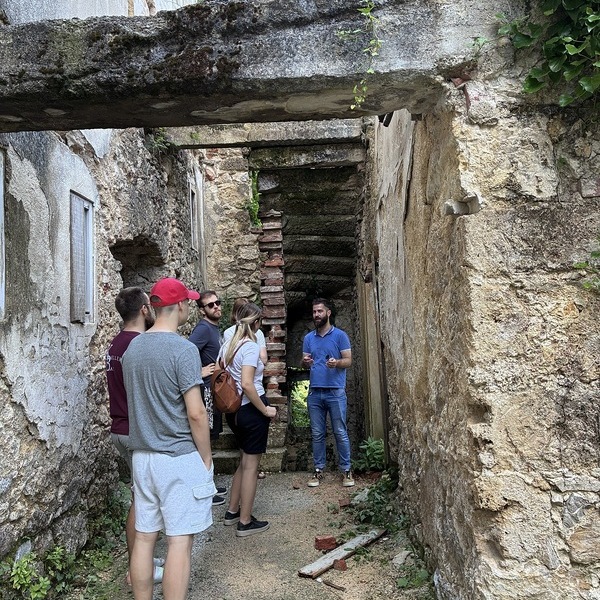
So we came. KHG wheels on tour, six daring people — Steffi, Nikolina, Joseph, Jack, Simon and Pawel — led by me, Ahmed, their overenthusiastic Bosniak guide, welcomed to my former Islamic high school, the Džemaludin Čaušević madrasa in Cazin, with a single quest for three July days: to see how this Abrahamic coexistence works.
In Europe, where the Catholic and more broadly Christian tradition predominates, such settings are extremely rare. The Jewish community in the land of the golden lily is concentrated in the capital, so unfortunately we could not visit the synagogue. On top of all that, I had it in mind that I might bring some golden lilies back with me to Austria — my room would feel like home.
FRIDAY — IT IS ALWAYS TIME FOR A COFFEE
Our first stop was the madrasa — my old school, which had also given us a roof for those three days — and coffee with Prof. Harun Pajić. The director, Prof. Zuhdija Handanović, was away in Turkey, so we did not catch him. It was good to walk through memories. A sip of traditional Bosnian coffee, and talk.
Bosnian coffee is a bit peculiar: somehow you can drink it five times a day and still never say no to another cup. A Linzer torte as a thank you to Prof. Harun Pajić and Prof. Zuhdija Handanović — this blend of traditional Austrian cake and Bosnian coffee sits just right.
Next, the restaurant Magical Lamp, where my family, the Hasanagićs, took us in. Ćevapi, gulaš and good talk — how do you say no to that? Then dessert, out in the village of Hasanagić (they did not believe me when I told them, so they had to snatch a picture of the sign): baklava, hurmašice, ice cream. A simple living room, with space enough for all of us to sit. It brings back my childhood memories. It feels peculiar to be welcoming so many different people into my home, to my own golden lilies.
Auf Wiedersehen, village of Hasanagić! A Linzer torte for you as well. Thank you for having us — and thank you for having me, after so long. See you soon, my golden lilies.
All that travelling in hot weather — a swim is a must! The Una, the river the Romans named “the one,” is unique, beautiful, and always a little cold (maybe that is her charm). Perfect. But be careful: the river does not forgive recklessness.
SATURDAY — CHURCHES, MOSQUES, AND RAIN
A cloudy morning on the way to Bihać. Rainy weather, but a sudden feeling of unity and curiosity; the inner child pops up unexpectedly. All that playfulness led us to notice the new Church of St. Anthony of Padua, where Sister Simplicija — simple and beautiful, as her name says — welcomed us in.
She was busy preparing the church for Sunday’s christening, and the room was filled with beautiful decorations and flowers. Wonderful tour, hospitality and selflessness. We came prepared: a Linzer torte, to say thank you. “You made my day,” she said. “I will give most of this cake to the priest.” That is what makes you beautiful, Simplicija: you put the needs of other people before your own.
Doviđenja, Sister Simplicija, and thank you for having us.
Rain again? No problem — coffee and a round of Black Peter. That wonderful black cat did not expect to be tossed around a café table in Bihać, but life does have a strange tendency to surprise you, doesn’t it?
Four hundred metres from the café lie the remains of the twentieth-century Church of St. Anthony of Padua, destroyed during the Second World War by Allied bombing, and Fethija: the oldest Gothic building in the country, once St. Anthony’s original church, before the Ottomans reached Bihać.
Iconic, monumental and controversial! God is still worshipped there devoutly, five times a day — and it was Sister Simplicija who had said to us, speaking of Fethija: “Is God not the same for all of us?” The Church of St. Anthony of Padua has stood the test of time and has always found good ground to remain in its beloved Bihać. All of that history just makes you hungry! Lunch at the traditional Bosnian restaurant Sofra: ćevapi, begova čorba, tufahija, traditional Bosnian coffee. As the people of Bosnia and Herzegovina like to say: “We will drink it, even if there are a hundred things to do!”
On to Bosanska Krupa — a little Jerusalem, as they say, where an Orthodox church, a mosque and a Catholic church stand shoulder to shoulder. Then Rizo, a Bosniak Muslim entrusted with the keys of the Church of the Blessed Virgin Mary, let us in. Rizo, in Arabic, means satisfied. And we were all satisfied to see that differences can coexist — that after we go to our own temples, we can all stop by Rizo’s ice cream shop, have a coffee and an ice cream, and share a moment of the beauty of existence. Another Linzer torte, for Rizo. Hvala, Rizo, for everything.
We also had VIP security: Zuco, who followed us through the town — žuco means yellow, and it is what we call every dog with a bit of orange in him. He snacks; he protects or attacks random cars. Left or right, but never neutral.
On the way back to Cazin, to the old mosque and its chandelier — funded, they say, by Franz Joseph, and still shining. The chandelier was not switched on; it consumes a lot of electricity. Even if some things are outdated, replacing them would mean replacing history — and it is still there as a sign that coexistence is possible if we truly try. In coexistence, growth can happen.
SUNDAY — THE RIVER, THE CASTLE, THE BORDER
First stop, the bakery — burek and an easy morning. Somehow, it was always time to eat or to drink coffee. Then Ostrožac Castle, where Isabella von Berks fell in love with the landscape and decided to pour her life savings into building a beautiful mansion. Some view you had, Ms. von Berks. Maybe she also wanted to bring a golden lily back home? Or did she simply like the view over the Una? I guess we will never know.
A hot day — the Una is calling. Still beautiful, still cold. A nice, careful swim, and then the journey back to Austria. A bakery stop before the border with Croatia. “No, I will pay for everything, you will not,” Joseph said. We coexisted, we shared, and everyone was exactly as they are — somehow we could be ourselves and part of the group at the same time. So it is possible!
A few days after coming back to Austria, it occurred to me that I had not snatched a single golden lily to keep in my room. A bit of googling told me that no one actually does that: the golden lily will remain an endemic species that grows only in the Dinaric mountains of Bosnia and Herzegovina. Because of what it needs from the soil, it would be very difficult to cultivate. Coexistence is similar — it needs the right soil, just like the golden lily.
If you are not careful, it will not survive. In other lands, different unique lilies grow. They are colourful, different, big and small. But they are all beautiful: you only have to take care of them and let them be as they are. Maybe I can go outside and see those lilies as they are. Maybe I can love them as I love my golden lilies, and maybe they can love me back.
Ah, u perju zambakovu / Tvoja duša sanke snije…
In the lily’s petals, your soul dreams its dreams.
— Musa Ćazim Ćatić, “Zambak”