
Parish- and Pilgrimage Church "Our Lady on the Mountain"
The South Portal
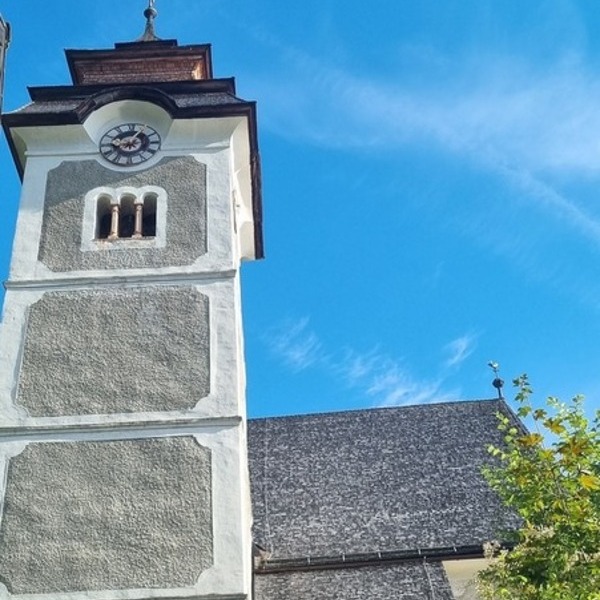
Most visitors enter the church through the southern entrance. Passing through the tower, they arrive at the magnificent portal of 1519, crafted from red Salzburg marble. Its refined design, the finely carved central mullion featuring the Virgin Mary, and the beautifully wrought iron doors bear witness to exceptional craftsmanship and deep devotion.
Frescoes Above the Portal
Above the portal are frescoes by an unknown master, restored in 1910, 1936, and 1962. They are believed to belong to the Danube School and depict Christ Carrying the Cross and the Crucifixion. Particularly remarkable is the extremely rare representation of the "Toothache Christ" in the fresco on the right.
The Crucifixion Group in the Vestibule
In the entrance vestibule, visitors encounter an impressive late Gothic Crucifixion group dating from around 1500. It is attributed to the master who created the Marian altar. The expressive face of the crucified Christ and the figure of Saint John are particularly striking.
The Main Nave
The main body of the church is an impressive two-aisled hall church, culminating in the east with a double choir that provides a dignified and harmonious conclusion to the interior. At its centre stands the distinctive octagonal pillar, branching upward like a palm tree to support the magnificent star vault. This pillar also marks the transition between the massive western section with the organ gallery and the lighter, more slender eastern choir.
Within the eastern choir, three additional columns support the vault, creating a sense of harmony and balance. While the structural ribs are fashioned from durable Dachstein limestone, the decorative architectural details have been finely carved from sandstone. Together they create an impressive blend of structural strength and artistic elegance.
Interior Furnishings
To the right of the entrance stands a representation of the Most Holy Trinity, reminding us of our profession of faith in the Triune God. This sculptural group, rediscovered and carefully restored, has been returned to its rightful place within the church. It invites visitors to contemplate the communion of the Father, the Son, and the Holy Spirit as the heart of the Christian faith.
On either side of the altars are the beautifully carved choir stalls depicting the Twelve Apostles and Saint Paul. Dating from the late seventeenth century, they are outstanding examples of fine craftsmanship. During liturgical celebrations they served as places of honour: those on the right for the dignitaries of the Hallstatt salt mines, and those on the left for the senior officials of the market town.
The Stations of the Cross leading to the organ gallery were installed during the church renovation in 1967. The paintings were restored by the academic painter and conservator Eduard Frohwent of Bad Ischl and placed in newly crafted wooden frames. A commemorative panel beneath the Stations recalls the benefactors and the dedication of the original Stations of the Cross on 16 August 1735.
The organ stands within a neo-Gothic case and incorporates parts of the oldest known organ dating from 1720, together with later additions. It underwent a complete restoration in 1998–99 and was solemnly blessed for the Millennium in the year 2000 by Archbishop Dr Alois Wagner, a great admirer and friend of Hallstatt.
To the left of the neo-Gothic Rood Altar hangs a beautiful painting of Christ Carrying the Cross, executed on wood in 1653. To its right stands the finely wrought iron gate before the so-called Eysselsberg Gallery, an outstanding example of traditional iron craftsmanship.
The pulpit, completed in 1905, is a distinguished work of marble and oak. Since the restoration of 2002 it has stood beside the baptismal font. Decorated with reliefs of the Latin Church Fathers, it—like the neo-Gothic Rood Altar—was created by the Hallstatt School of Woodworking.
The Baptistery
The Baptistery is the place where the Sacrament of Baptism is celebrated. The late Gothic baptismal font, created around 1500 and moved to its present location during the church restoration of 2002, symbolises entry into the Church through Baptism. Countless Christians have been welcomed into the community of faith at this venerable font.
The Pietà on the north side of the church is a moving depiction of the Sorrowful Mother holding the body of her Son, Jesus Christ, after His removal from the Cross. It invites the faithful to quiet contemplation and compassionate reflection on Christ's Passion.
The Neo-Gothic Rood Altar
The neo-Gothic Rood Altar, with its marble altar table and marble facing, is another masterpiece created by the Hallstatt School of Woodworking. During the restoration and re-Gothicisation of the church between 1888 and 1895, the earlier Baroque altar by Schwanthaler was removed and replaced by a new altar of the same size, designed by Professor Ritter von Riewel. Over the course of three years, teachers and students worked together to create this remarkable work of sacred art. The depiction of the Crucifixion was intentionally retained, resulting in the church's second great winged altar.
Archaeological Discoveries
Archaeological excavations beneath the choir uncovered the foundations of the original Romanesque eastern wall. Romanesque graves containing human remains were also discovered beneath the pews. In addition, the columns supporting the organ gallery stand upon the foundations of the earlier Romanesque church.
Restorations
The entire interior was comprehensively restored in 1966–67 under the then parish priest and later honorary citizen of Hallstatt, Monsignor Johann Weidinger (†), and again in 2002 under Parish Priest August Stögner. Today, the church interior closely reflects its presumed appearance around the year 1510.