
Charnel House
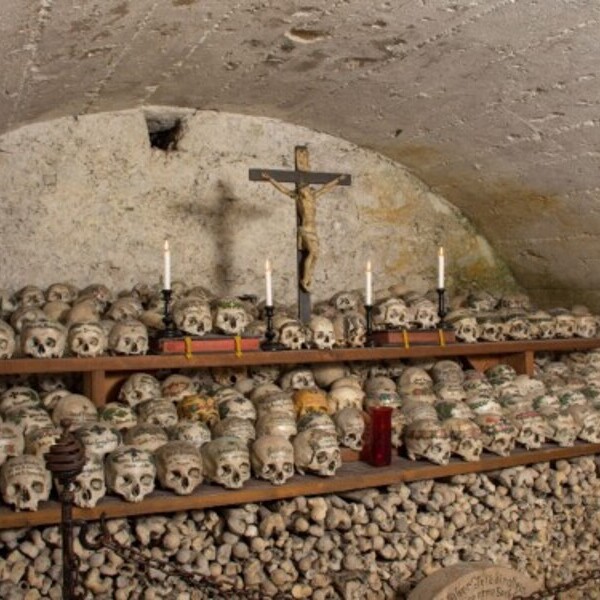
Anyone who enters St Michael’s Chapel and looks into the charnel house in the crypt beneath the chapel encounters an extraordinary place. Around 2,000 skulls rest here, more than 600 of them artistically painted and inscribed. But at first, something else catches the eye. The cross.
Before it burns the sanctuary lamp.
Directly beneath it rest two skulls painted exclusively with snakes.
Many visitors initially see skulls, bones and a cross. But those who pause for a moment discover that this place proclaims a message.
The Victory over Evil
Above the charnel house is the sacred space of St Michael’s Chapel. The altarpiece depicts the Archangel Michael in battle with Lucifer. The fallen angel is shown defeated.
A Gothic stained-glass panel dating from around 1450/60 already depicts the Archangel Michael holding the scales of souls: the good and evil deeds of a person are weighed, while the devil attempts to influence the scales in his favour.
One striking detail is the devil’s tail in the altarpiece of St Michael’s Altar: it ends in a barb – a symbol of resistance against God.
The same symbol can also be found in the charnel house. Snakes are depicted on two skulls, and on both of these snake-painted skulls the barb has deliberately been rendered in the same way. The snake recalls the biblical story of Adam and Eve and their disobedience towards God. This makes the placement of these skulls all the more striking: above the two snake-painted skulls rises the Cross of Christ. In this way, the imagery of St Michael’s Chapel is linked with that of the charnel house: Michael defeats evil – but through the Cross and Resurrection, Christ conquers sin and death.
The Apostle Paul calls Christ the new Adam. What was lost through the first Adam is given to us anew in Christ. The Cross thus becomes a sign of victory and of hope in eternal life.
The Light That Never Goes Out
Before this Cross burns the sanctuary lamp. It reminds us of Christ, the Light of the World, and of the hope with which the Church entrusts her dead to God:
“Eternal rest grant unto them, O Lord,
and let perpetual light shine upon them.”
The sanctuary lamp burns here for all the deceased whose remains rest in the charnel house. In the Preface of the Catholic funeral liturgy, the Church prays the words that also form the title of this text:
“For your faithful, O Lord, life is changed, not ended.”
These words are the key to understanding the Hallstatt Charnel House.
This place is not about death. - It is about life.
Not about mortality. - But about hope.
Not about the end. - But about Easter.
Anyone who looks at the Hallstatt Charnel House only with their eyes sees the remains of generations past. Those who view it in the light of the Christian faith discover a powerful testimony to the hope of resurrection.
A Place of Faith
The charnel house is not a museum. It is part of a consecrated sacred space. To this day, the sanctuary lamp burns here. To this day, people pray here. To this day, the Cross, the light and the mortal remains of generations past together proclaim the hope of resurrection. Those who enter this space are therefore invited not only to look, but also to become still for a moment.
Perhaps to pray the Our Father.
Perhaps to remember a name.
Perhaps to think of someone they miss.
A Tradition of Reverence
The history of the Hallstatt Charnel House stretches back many centuries. Because of Hallstatt’s unique geographical location, the cemetery surrounding the parish church has always been small and could hardly be extended. For this reason, graves were reopened after a longer period of rest – usually after around 15 years.
To this day, however, a number of misconceptions persist about the Hallstatt cemetery. The deceased were, and still are, buried in Hallstatt in the normal manner, lying in a coffin. They are neither buried standing upright nor – as is sometimes claimed – buried without their heads because of the charnel house. The graves themselves are also dug in the usual way.
What is actually smaller because of the limited space is the visible border of the graves at ground level. This space-saving design of the cemetery has nothing to do with the manner in which the deceased are buried. Contrary to another frequently repeated assumption, not all deceased persons were transferred to the charnel house after the end of the resting period.
Transfer to the charnel house took place exclusively at the request of the deceased or their relatives.
Many Hallstatt families consciously chose this form of remembrance. It is striking that this wish was often passed down through several generations within the same families. A particularly notable example is the Brandner family. Members of this family served as Hallstatt’s gravediggers and were therefore connected with the cemetery and the charnel house in a special way. The skulls of several members of this family can still be found together in the charnel house today – to the left of the priests’ skulls resting there on books.
And this tradition has not ended. Even today, at the explicit request of a deceased person or their relatives, a skull may be placed in the Hallstatt Charnel House after the appropriate resting period. This now happens only rarely – but the possibility still exists.
The charnel house is therefore not the result of a general obligation, but rather a testimony to personal decisions and to Hallstatt family history lived across generations.
The Journey of a Skull
If transfer to the charnel house had been requested, the remains were carefully cleaned after the grave was reopened. The skull was then placed on the wooden board beneath the roof of the so-called gravedigger’s house. There it remained for an extended period, exposed to the changing light of the sun and moon. Light, air and time allowed the bone to dry and become pale. Only then did the painting begin.
The skull was inscribed with the name of the deceased and decorated with flowers, leaves, Christian signs or other symbols. In this way, it became a personal memorial.
Around 2,000 Skulls – More Than 600 of Them Painted
Today, the Hallstatt Charnel House contains around 2,000 skulls. More than 600 of them are artistically painted and inscribed. The tradition of painting skulls in Hallstatt can be traced back at least to the 18th century. It is important to understand that the charnel house and the painting of skulls are not the same tradition. Numerous skulls in the charnel house are unpainted. Painting was not a requirement for admission to the charnel house, but rather a special form of personal remembrance. Many of the painted skulls bear the name of the deceased. In this way, it remains visible that behind each one was a person with a story of their own.
Scientific Interest
The collection of skulls in the Hallstatt Charnel House has, for the most part, remained in its original location to this day. Individual skulls, however, were taken to Innsbruck during the 20th century for scientific research and to the anthropological collection of the Natural History Museum in Vienna. The collection there also contains a painted Hallstatt skull featuring the rare snake motif.
The Language of Hope
The different painted decorations also have a language of their own.
Ivy recalls everlasting life. Because it remains green even in winter, it became a symbol of faithfulness and of hope in eternal life.
Oak leaves speak of strength, constancy and faithfulness.
Wreaths of flowers express love, gratitude and enduring bonds. At the same time, the unbroken circle may be understood as a symbol of eternity.
Crosses and other Christian symbols express faith and hope in the resurrection.
The painted decorations therefore tell us not only of artistic skill. They speak of people, of remembrance, of bonds that endure and of hope. For before God, no one remains nameless. He knows every person by name.
The Priests of Hallstatt
In the front section of the charnel house rest the skulls of those priests who served the people of Hallstatt in their pastoral ministry. They rest upon books. The books recall their task of proclaiming the Word of God, interpreting Holy Scripture and helping people to understand the faith and the Christian hope. Even in death, this symbol remains connected with their priestly ministry.
The Charnel House Tells of Easter
Many people leave the Hallstatt Charnel House deeply impressed. Some because of its history. Some because of its artistically painted skulls. But perhaps something else remains much more deeply in the heart:
The Cross.
The sanctuary lamp.
The two snake-painted skulls.
And the words of the Church:
“For your faithful, O Lord, life is changed, not ended.”
Anyone who carries these words with them carries away the true message of the Hallstatt Charnel House.
For this place does not speak only of death.
It speaks of Christ.
Of his victory over evil.
Of his victory over death.
Of the hope that has sustained the Church since Easter.
And of the promise that Jesus himself gives to all who believe:
“I am the resurrection and the life. Whoever believes in me will live, even though they die.”
(John 11:25)
Did You Know?
• Around 2,000 skulls are kept in the Hallstatt Charnel House, more than 600 of them painted and inscribed.
• The charnel house remains part of a consecrated sacred space to this day and is not a museum.
• Not all deceased persons were placed here. Transfer to the charnel house took place exclusively at the request of the deceased or their relatives.
• The same Hallstatt families often maintained this tradition over several generations.
• The tradition continues to this day: upon special request, a skull may still be placed in the Hallstatt Charnel House.
• After a grave was reopened, the skulls were cleaned and placed on the wooden board beneath the roof of the so-called gravedigger’s house, where light, air and time allowed them to dry and become pale.
• The tradition of painting skulls in Hallstatt can be traced back at least to the 18th century.
• The skulls of Hallstatt’s priests rest upon books – a symbol of their ministry of proclaiming the Gospel.
• Before the Cross burns the sanctuary lamp for the deceased – a sign of the Christian hope of resurrection.